
Implementasi Pendidikan Karakter SMP IT Islam Terpadu Iqro Nogosari
DOI:
https://doi.org/10.36668/jal.v14i1.1342Abstract
Abstract: This study aims to explore the implementation of character education at SMP IT Islam Terpadu Iqro Nogosari. The issues addressed include the rise in negative behaviors among adolescents and the low awareness of social responsibility. The research employs a qualitative approach with a case study method. Data were collected through in-depth interviews, participatory observations, and document analysis. The findings reveal that character education is integrated through both the learning process and school culture. Teachers incorporate character values into teaching modules and learning activities, as well as through routine activities such as congregational dhuha prayers and morning dhikr. The school culture further reinforces student character through good habits and religious activities. This implementation of character education successfully produces a generation that is intellectually, emotionally, and spiritually intelligent.
Keywords: character education, learning process, school culture, SMP IT Islam Terpadu Iqro Nogosari
References
Ade Salamun dan Sofyan Sauri, “Isu dan Masalah dalam Analisis Evaluasi dan Pengembangan Kebijakan Pendidikan Agama Islam,” Edukasi Islami: Jurnal Pendidikan Islam, 12.01 (2023), 219–40 <https://doi.org/10.30868/ei.v12i01.2859>.
Agus Richo Prehananto, Penerapan Kurikulum Pendidikan Karakter SMP IT Islam Terpadu Iqro Nogosari, 2024.
Agus Wibowo, Managemen Pendidikan Karakter di Sekolah. (Yogyakarta: Pustaka Pelajar, 2013), 40.
Anjas Pratiwi dan M. Solikul Hadi, “The Urgence of Siti Bariyah’s Thinking in Islamic Education 5.0,” Journal of Contemporary Islamic Education, 2.2 (2022), 147–65 <https://doi.org/10.25217/jcie.v2i2.2579>.
D. Koesoema, Pendidikan Karakter: Strategi Mendidik Anak Di Zaman Global. (Jakarta: Grasindo, 2007), 54.
Edi Kurniawan Fahmi Husein, Moh Solikul Hadi, “Strategi Digital Detox untuk Siswa?: Efektivitas Pendidikan Islam melalui Program Bimbingan Konseling pada Anak SMA / SMK di Yogyakarta Penerbangan AAG Adisutjipto , penerapan strategi Digital Detox melalui program,” 13 (2024), 358–69.
Hasriadi, “Model Pembelajaran Jarak Jauh Pendidikan Agama Islam Berbasis Teknologi Informasi dan Komunikasi,” Jurnal Konsepsi, 11.1 (2022), 85–97.
J. W. Creswell, Research Design: Qualitative, Quantitative, and Mixed Methods Approaches (4th Ed.). (Thousand Oaks, CA: Sage, 2014), 189.
J. W. Santrock, Educational Psychology. (New York: McGraw-Hill, 2011), 45.
M Sayyidul Abrori dan Moh. Solikul Hadi, “Integral Values in Madrasah: to Foster Community Trust in Education,” Istawa?: Jurnal Pendidikan Islam, 5.2 (2020), 160 <https://doi.org/10.24269/ijpi.v5i2.2736>.
M. B. Miles and A. M. Huberman, Qualitative Data Analysis: An Expanded Sourcebook (2nd Ed.) (Thousand Oaks, CA: Sage, 1994), 10.
Moh Solikul Hadi, Abdul Kahfi Amrullah, dan Khoerul Anwar, “Journal of Islamic Scriptures in Non-Arabic Societies Membentuk Peserta Didik Menjadi Pribadi Ulul al-bab Prespektif,” 1.1 (2024), 61–62.
Nabeel Mahdi Althabhawi, Zinatul Ashiqin Zainol, dan Parviz Bagheri, “Society 5.0: A New Challenge to Legal Norms,” Sriwijaya Law Review, 6.1 (2022), 41–54 <https://doi.org/10.28946/slrev.Vol6.Iss1.1415.pp41-54>.
Prehananto, Penerapan Kurikulum Pendidikan Karakter SMP IT Islam Terpadu Iqro Nogosari.
Riyani Novianti, Pembiasaan Pendidikan Karakter Melalui Kegiatan Non Kurikuler SMP IT Islam Terpadu Iqro Nogosaridi, 2024.
Siti Khairina Rahayu, “Penguatan kesadaran bela negara pada remaja milenial menuju Indonesia emas,” Pedagogika, 2021, 134–51.
Sriyanti Nihi Haryati, Nurfitri Sahidun, “Pendekatan Psikologi Dalam Penanganan Korban Kekerasan Seksual Terhadap Perempuan Dan Anak,” Jurnal Kajian Perempuan, Gender dan Anak, 16.2 (2022), 297.
Sukro Muhab et al., Standar Mutu Kekhasan Sekolah Islam Terpadu Edisi Kelima (Depok: JSIT Indonesia, 2023), 28.
Sumintak Sumintak, Sefti Wiwin Lenwinsky, dan Ade Irfan, “Dekadensi Moral Terhadap Degradasi Lingkungan di Daerah Aliran Sungai Cibanten,” Jurnal Studi Agama, 7.2 (2023), 41–55 <https://doi.org/10.19109/jsa.v7i2.19302>.
Syafri Rizka Martabe Nasution, “Pendidikan Islam Dalam Sistem Pendidikan Nasional,” Studi Multidisipliner: Jurnal Kajian Keislaman, 4.2 (2017), 127–46 <https://doi.org/10.24952/multidisipliner.v4i2.932>.
T. Lickona, Educating for Character: How Our Schools Can Teach Respect and Responsibility. (New York: Bantam Books, 2012), 67.
Utari Vitriawati, Penerapan Pendidikan Karakter SMP IT Islam Terpadu Iqro Nogosari, 2024.
Y. S. Lincoln and E. G. Guba, Naturalistic Inquiry (Newbury Park, CA: Sage, 1985), 219.
Zakariyah Zakariyah, Muhamad Arif, dan Nurotul Faidah, “Analisis Model Kurikulum Pendidikan Agama Islam Di Abad 21,” At-Ta’Dib: Jurnal Ilmiah Prodi Pendidikan Agama Islam, 14.1 (2022), 1–13 <https://doi.org/10.47498/tadib.v14i1.964>.
Downloads
Published
Issue
Section
License
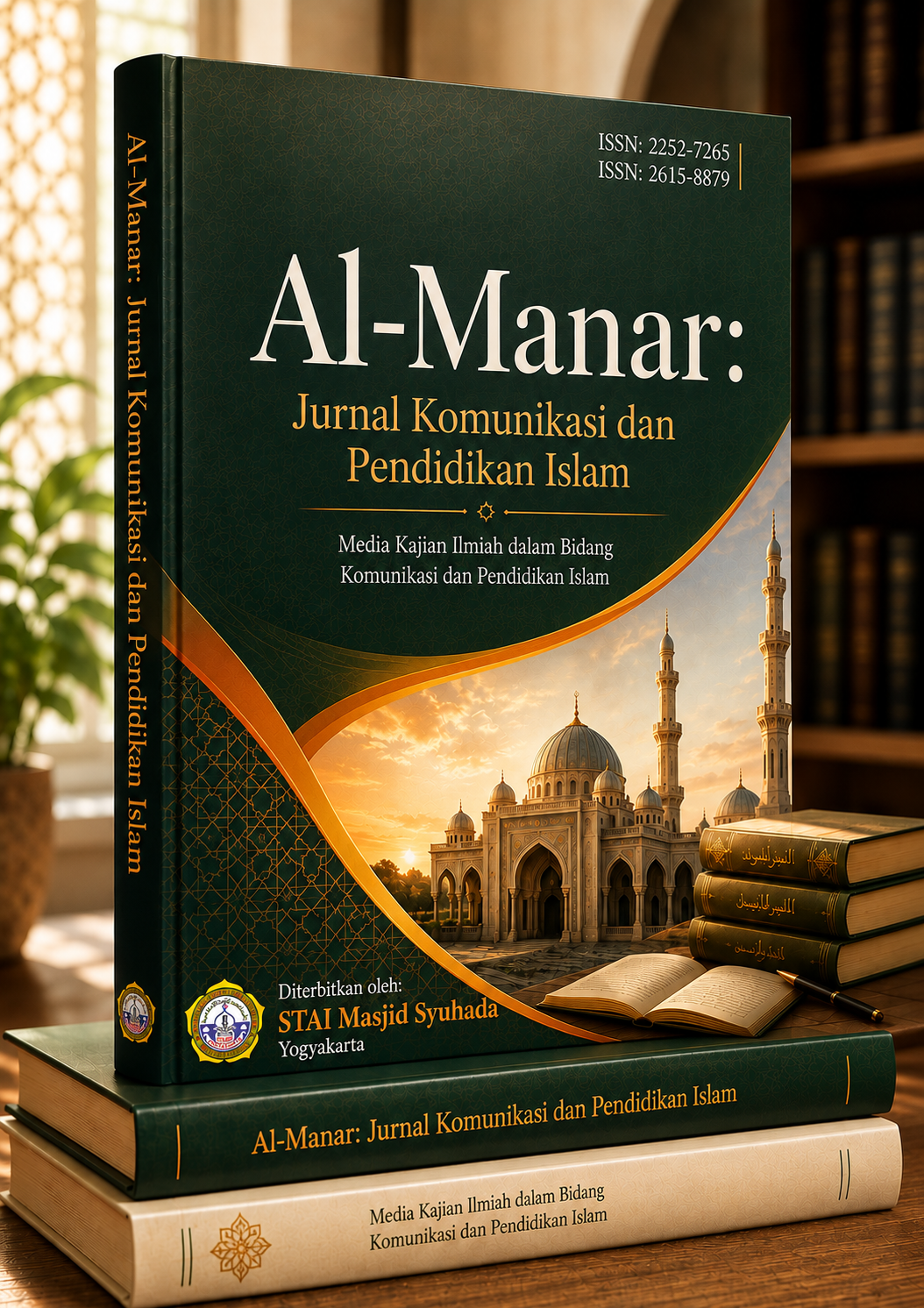
Authors who publish in AL-MANAR: Jurnal Komunikasi dan Pendidikan Islam agree to the following terms:
- Authors retain copyright and grant the journal right of first publication with the work simultaneously licensed under a Creative Commons Attribution-NonCommercial-ShareAlike 4.0 International License that allows others to share the work with an acknowledgment of the work's authorship and initial publication in this journal.
- Authors are able to enter into separate, additional contractual arrangements for the non-exclusive distribution of the journal's published version of the work (e.g., post it to an institutional repository or publish it in a book), with an acknowledgment of its initial publication in this journal.
- Authors are permitted and encouraged to post their work online (e.g., in institutional repositories or on their website) prior to and during the submission process, as it can lead to productive exchanges, as well as earlier and greater citation of published work. (See The Effect of Open Access)
How to Cite





