
Perencanaan Peningkatan Kualitas dan Kesesuaian Pendidikan Agama Islam dengan Tantangan Revolusi Industri 4.0
DOI:
https://doi.org/10.36668/jal.v13i02.1074Abstract
Abstract: Education in Indonesia needs to adapt to technological advances and technological integration. Modernization of Islamic education based on character education is a necessity to create education that is in accordance with the needs of the millennial generation. This study aims to determine the problems of Islamic education that are currently occurring and the challenges of Islamic education in the future. Furthermore, this study will seek solutions so that the world of Islamic education can compete and even become a reference in the implementation of education in Indonesia. The research method used is a literature study by collecting data through documentation and descriptive-analytical methods. The transformation of Islamic education is needed to overcome the existing crises and problems, in addition, strengthening Islamic educational institutions also needs attention, including strengthening Islamic education management, Islamic education leadership, and education policy reform. All of these efforts aim to form a whole and superior generation, which is competitive, creative, innovative, has character, is independent, loves the homeland, and is religious in facing Era 4.0, where humans are required to move quickly, precisely, effectively, and efficiently. Therefore, planning to improve the quality of Islamic religious education in this ever-evolving era is very important.
Keywords: Quality Improvement Planning, Islamic Religious Education, Industrial Revolution 4.0
References
Abdussamad, H. Zuchri, and M. Si Sik. Metode Penelitian Kualitatif. CV. Syakir Media Press, 2021. https://books.google.com/books?hl=en&lr=&id=JtKREAAAQBAJ&oi=fnd&pg=PR5&dq=METODE+PENELITIAN+KUALITATIF&ots=vDCzyV45O1&sig=_4YhBSIwAbIiocP3mDOsxnCpj3o.
Asrulla, Asrulla, Tuti Indriyani, and Firdaus Jeka. ‘Tantangan Manajemen Sumber Daya Manusia Dalam Pendidikan Di Era Society 5.0’. Jurnal Genta Mulia 15, no. 1 (2024): 161–78.
Bararah, Isnawardatul. ‘Efektifitas Perencanaan Pembelajaran Dalam Pembelajaran Pendidikan Agama Islam Di Sekolah’. Jurnal MUDARRISUNA: Media Kajian Pendidikan Agama Islam 7, no. 1 (2017): 131–47.
Destriani, Destriani. ‘Pembelajaran Pendidikan Agama Islam Berbasis Moderasi Beragama Menuju Society Era 5.0’. INCARE, International Journal of Educational Resources 2, no. 6 (2022): 647–64.
Destriani, Destriani, and Idi Warsah. ‘Pemanfaatan Model Pembelajaran Flipped Classroom Pada Pembelajaran Pendidikan Agama Islam Di Sekolah Dasar Islam Terpadu’. SITTAH: Journal of Primary Education 3, no. 2 (2022): 175–90.
Fadhila, Sayyida Safir, and Muhammad Miftah. ‘Sejarah Pendidikan Di Indonesia Pasca Orde Baru Dan Tantangannya Menghadapi Era Disrupsi’. MA’ALIM: Jurnal Pendidikan Islam 5, no. 1 (2024): 41–55.
Fitriyanti, Riska, and Muhammad Sirozi. ‘Perencanaan Peningkatan Mutu Dan Relevansi Pendidikan Agama Islam Di Era Revolusi Industri 4.0’. Jurnal Inovasi, Evaluasi Dan Pengembangan Pembelajaran (JIEPP) 4, no. 3 (2024): 485–91.
Halimurosid, Asep. ‘Strategi Pembelajaran Pendidikan Agama Islam Dalam Menghadapi Era Revolusi Industri 4.0’. Jurnal Pendidikan Dan Konseling (JPDK) 4, no. 4 (2022): 3642–50.
Hasanah, Mizanul, Priatna Sandy, Mahmud Mannan, and July Amalia Nasucha. ‘Analisis Strategi Perencanaan Mutu Satuan Pendidikan Di Lembaga Pendidikan Islam Di Indonesia’. Attadrib: Jurnal Pendidikan Guru Madrasah Ibtidaiyah 5, no. 2 (2022): 108–19.
Hidayat, Tatang, and Abas Asyafah. ‘Konsep Dasar Evaluasi Dan Implikasinya Dalam Evaluasi Pembelajaran Pendidikan Agama Islam Di Sekolah’. Al-Tadzkiyyah: Jurnal Pendidikan Islam 10, no. 1 (2019): 159–81.
Murtafiah, Nurul Hidayati. ‘MANAJEMAN TATALAKSANA LEMBAGA PENDIDIKAN ISLAM DALAM MENINGKATKAN MUTU PELAYANAN PENDIDIKAN’. At-Tajdid: Jurnal Pendidikan Dan Pemikiran Islam 7, no. 2 (2023): 425–36.
Nadlir, M. ‘Perencanaan Pembelajaran Berbasis Karakter’. Jurnal Pendidikan Agama Islam (Journal of Islamic Education Studies) 1, no. 2 (2013): 338–52.
Putri, Neni, Oma Aprida, Jumira Warlizasusi, Abdul Sahib, and Destriani Destriani. ‘Peran Supervisi Dalam Meningkatkan Kualitas Manajemen Pendidikan Islam Di Sekolah’. Berkala Ilmiah Pendidikan 4, no. 3 (2024): 550–63.
Putri, Neni, and Emmi Kholilah Harahap. ‘Strategies to Improve the Quality of Education in Mas 01 Kepahiang’. International Journal of Health, Economics, and Social Sciences (IJHESS) 6, no. 3 (2024): 776–84.
Putri, Neni, Murni Yanto, Muhammad Istan, and Destriani Destriani. ‘REVOLUSI TEKNOLOGI DALAM PENDIDIKAN ISLAM DI ZAMAN GLOBALISASI’. Tarbiyatuna Kajian Pendidikan Islam 8, no. 2 (2024): 214–31.
Rabiah, Sitti. ‘Manajemen Pendidikan Tinggi Dalam Meningkatkan Mutu Pendidikan’. Jurnal Sinar Manajemen 6, no. 1 (2019): 58–67.
Warsah, Idi, Destriani Destriani, Asri Karolina, and Riza Faishol. ‘Strategi Guru Dalam Mengembangkan Kecerdasan Linguistik Siswa’. Jurnal Tarbiyatuna: Kajian Pendidikan Islam 7, no. 1 (2023): 054–069.
Yanto, Murni, Idi Warsah, Ruly Morganna, Imron Muttaqin, and Destriani Destriani. ‘Intercultural Sensitivity of Educational Management Students as the Future’s Educational Leaders in Indonesia’. The International Journal of Sociology of Education 11, no. 3 (2022): 265–90.
Downloads
Published
Issue
Section
License
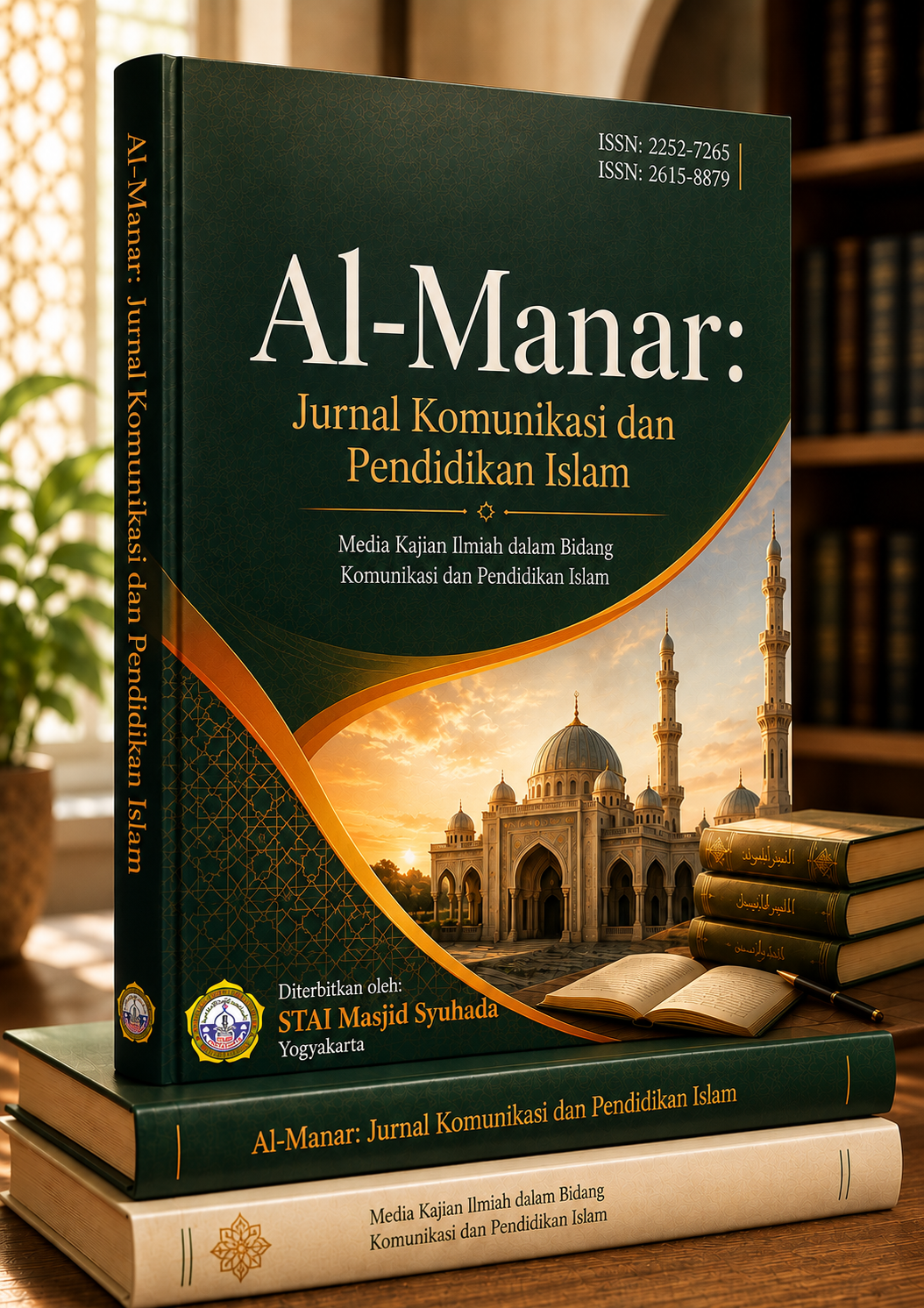
Authors who publish in AL-MANAR: Jurnal Komunikasi dan Pendidikan Islam agree to the following terms:
- Authors retain copyright and grant the journal right of first publication with the work simultaneously licensed under a Creative Commons Attribution-NonCommercial-ShareAlike 4.0 International License that allows others to share the work with an acknowledgment of the work's authorship and initial publication in this journal.
- Authors are able to enter into separate, additional contractual arrangements for the non-exclusive distribution of the journal's published version of the work (e.g., post it to an institutional repository or publish it in a book), with an acknowledgment of its initial publication in this journal.
- Authors are permitted and encouraged to post their work online (e.g., in institutional repositories or on their website) prior to and during the submission process, as it can lead to productive exchanges, as well as earlier and greater citation of published work. (See The Effect of Open Access)
How to Cite





